
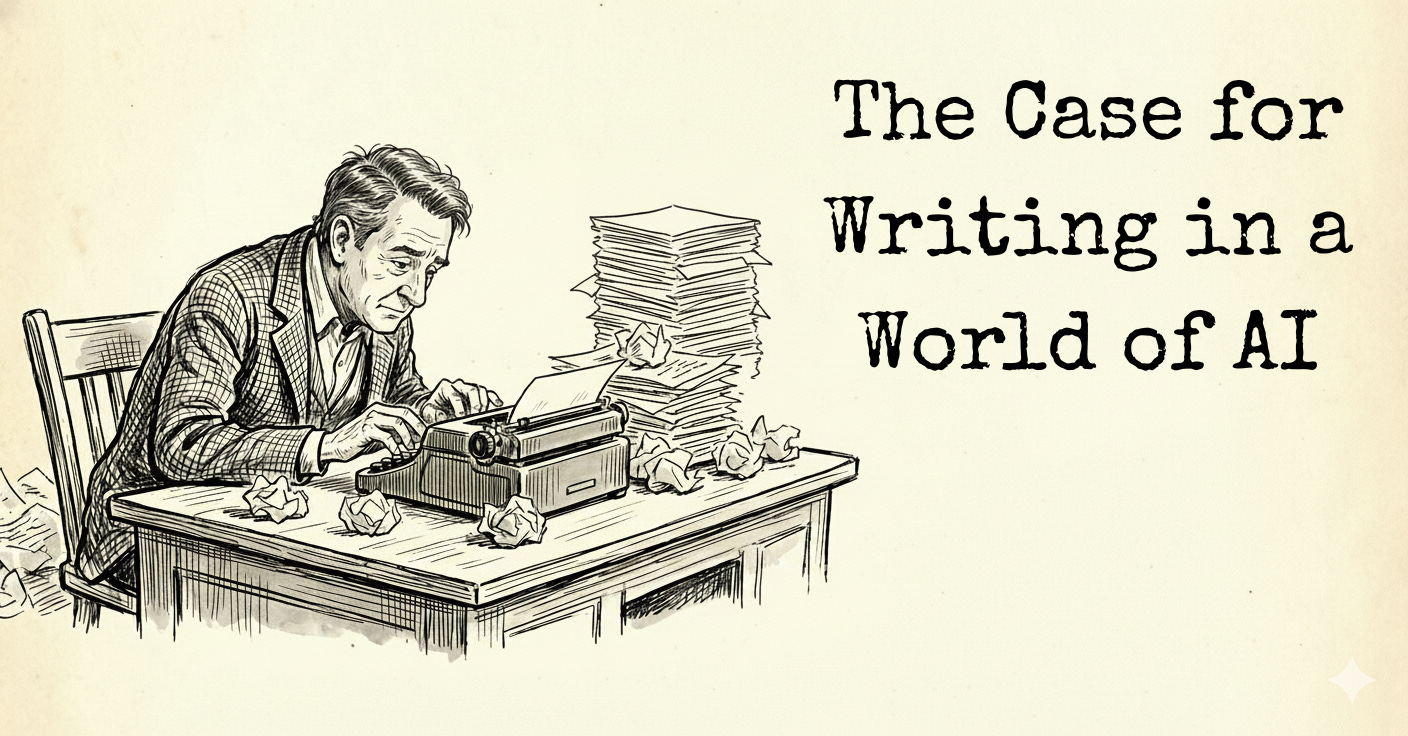
The Case for Writing in a World of AI
Six lessons if you want to be a writer in the age of AI

Let’s say it’s 1905 and you’re in the market for a new profession. Maybe it’s your sophomore year of college and you’re exploring careers. Or maybe you’re in your sixties and looking for a way to support your family instead of working your clerical job until you die (social security in the US didn’t exist until 1935).
Strikes and protests are happening in Russia ahead of the Bolshevik Revolution. Japan emerges as a world power after defeating Russia in a major naval battle. The New York Giants win the World Series. Your frock coat is made of heavy worsted wool.
Against this backdrop, you develop an affinity for the art and craft of making buggy whips. Your grandfather passed the trade and skills to your father. You go to your clerical day job, but in your spare time, you spend hours strolling the markets of New York’s lower west side to find the perfect animal intestine for twisting into the whip’s belly. In the evenings at the pub, you debate the best way to braid the plaiting with your mates. You protect your Australian sources of premium kangaroo hide to give you a competitive advantage. You’re hand-making buggy whips in your garage on nights and weekends, and you have a tiny stall at the Saturday market. The New York Times describes your buggy whips as “Top premium and bespoke whips suitable for today’s distinguished gentlemen.”
You’re selling a handful every weekend, but you think with enough marketing, expanded production, and wider distribution, you can go worldwide and dominate the buggy whip market. And quit your clerical job.
One night, your mate comes into the pub with a newspaper clipping with a picture of a contraption with four wheels, an engine, and a steering stick. “Hey, did you see this new thing? They call it the Duryea Motor Wagon.”
Fast Forward to Late 2025
You want to build a career as a writer. Maybe you’re studying journalism in college. Or maybe you’re 1,251 days from quitting your day job and you’re looking to start a writing retire-preneur gig.
Your mate texts you an article from Fast Company titled AI now writes more than half of new online articles. What’s next for human authorship?
Are we in writing’s buggy whip moment?
Maybe I’m biased, but I don’t think so
Let’s unpack the future of writing in an AI world, where I make the case that human-powered writing will become even more important than it already is.
Abundance Pushes People Toward Scarcity
Anyone using AI can produce A LOT of writing, and quickly. Internet platforms and Amazon will be flooded with posts, articles, and books, if they’re not already.
History has proven that when there is A LOT of something, humans naturally re-anchor their value systems to what is high-quality, scarce, and authentic.
Photography didn’t kill painting; fine art painting exploded.
Streaming didn’t kill music. Now I’ll travel to see JJ Gray or Michael Franti live.
The internet didn’t kill journalism. Now I pay for only the trusted news that I want, including several writers here on Substack.
Ebooks didn’t kill physical books. Special editions with beautiful covers and unique typography gained in popularity.
Mass-produced food drove the rise of specialty foods like craft coffee, sourdough bread, and farm-to-table.
Voice Matters
AI might make the production of plot, prose and outlines easier. AI definitely helps with research (fact check all your AI research, please). But AI can’t feel, it hasn’t experienced, it doesn’t have a worldview. AI hasn’t lived through trauma, ambition, regret, or loss. It doesn’t hope or crave.
I’ll define “voice” as the consistent and unique personality of the writer that shines through the prose.
Readers are drawn to voice. It’s why I read Stephen King (conversational, the everyman) and not William Faulkner (baroque and dense). Stephen King worked at a laundromat to make ends meet before his writing took off. Faulkner came from a prominent family, had a pony, and was introduced to guns and hunting at an early age.
I identify with King’s voice. Also Rex Stout’s and Louise Penny’s. I also appreciate Dan Koe’s voice while Scott Scheper isn’t my cup of tea.
I don’t identify with ChatGPT’s voice, whatever that is.
Storytelling is (arguably) the Oldest Art Form for a Reason
Storytelling predates writing. Humans told stories around the campfire and during hunts as a survival technique, to transmit knowledge and understanding, and as a form of teaching. Humans gravitate toward storytelling as a way to make sense of the world around them. Stories are how humans signal values.
But not all stories are created equal.
Cultures value the storyteller, not just the story. A storyteller’s reputation matters. Do you trust who’s telling you a story? Do you like them, respect them, share their values?
Probably depends on the story. I’ll watch anything by Vince Gilligan. Lara Logan, not so much.
People respond more strongly to narratives and stories when they like and trust the source. The story is a signal of the mind behind the page.
Someday, AI might be able to tell a story. But will it matter?
The Brand Is A Human
If the storyteller matters, the human is the brand. Audiences choose a brand based on worldview, credibility, personality, and trust.
It takes experimentation, consistency, and continuous improvement to build trust.
Established and trusted brands gain pricing power, relevance, and an audience.
It’s a flywheel. Write to build trust. Trust builds relevance. Relevance yields monetary value. Monetary value allows you to write more.
Focus on the flywheel.
AI might help make the writing better, but trust requires human to human connection.
Human Writers Thrive Where Trust Matters Most
Publishing trend forecasts point to mediums where credibility and lived experience matter.
Memoirs, essays, and journalism will thrive as humans prioritize connections to other humans.
Humans will seek out human-written lessons on coaching, creativity, and craft.
Eventually, your lowbrow and transactional writing will become AI-produced. Garden-variety romance novels, zombie apocalypse thrillers, and other potboilers will be mass-produced. Think James Patterson on steroids.
How long that will take is anyone’s guess.
Meanwhile, focus on your craft. Pursue mastery.
People Follow People
Communities and direct-to-reader ecosystems are on the rise. Substack, Patreon, and direct book sales are thriving platforms where humans can stay connected with creators.
If the brand is a human, then human-to-human interactions continue to matter. People will pay for access to personality, a similar worldview, and authenticity.
Communities, both live and digital, will expand as AI becomes more prevalent.
While working on your craft, also spend time building one-to-one relationships with your readers.
AI Increases the Number of People Who Want to Write
Ironically, more accessible tools for writing and learning to write will increase the number of people who want to write. As the barriers to entry decrease, demand goes up.
This has played out throughout history.
Digital cameras created more photographers.
Calculators expanded math as a subject, and the demand for math teachers increased.
Desktop publishing created more writers.
As the barriers decrease, the demand for human taste, mastery, and guidance goes up. The lower-quality stuff flounders, or finds a different audience, and mastery wins over the long run.
Six Lessons if You Want To Be a Writer in the Age of AI
I’m in, how about you?
Here are six guideposts if you’re looking to expand your writing platform in the age of AI.
Do it. It’s never been easier to learn to write and to find an audience.
Be unique and develop your voice. This takes writing. Lots of writing.
Learn the craft. Develop a deep understanding of the principles of writing. Don’t rely on AI as a crutch, you’ll fool no one.
Learn to use AI for what it’s good at: research, ideation, and proofing.
What you write matters. Cookie-cutter stories (e.g. romance) are out. Complex narratives, character-driven stories, theme-driven stories, and thought pieces are in.
Go direct to the reader. Take the time to build the email list and the social media accounts. Fight for every human interaction. Sell directly from your website.
Good luck, and let me know how it turns out.
1,250 days to go. Thanks for reading. :-)